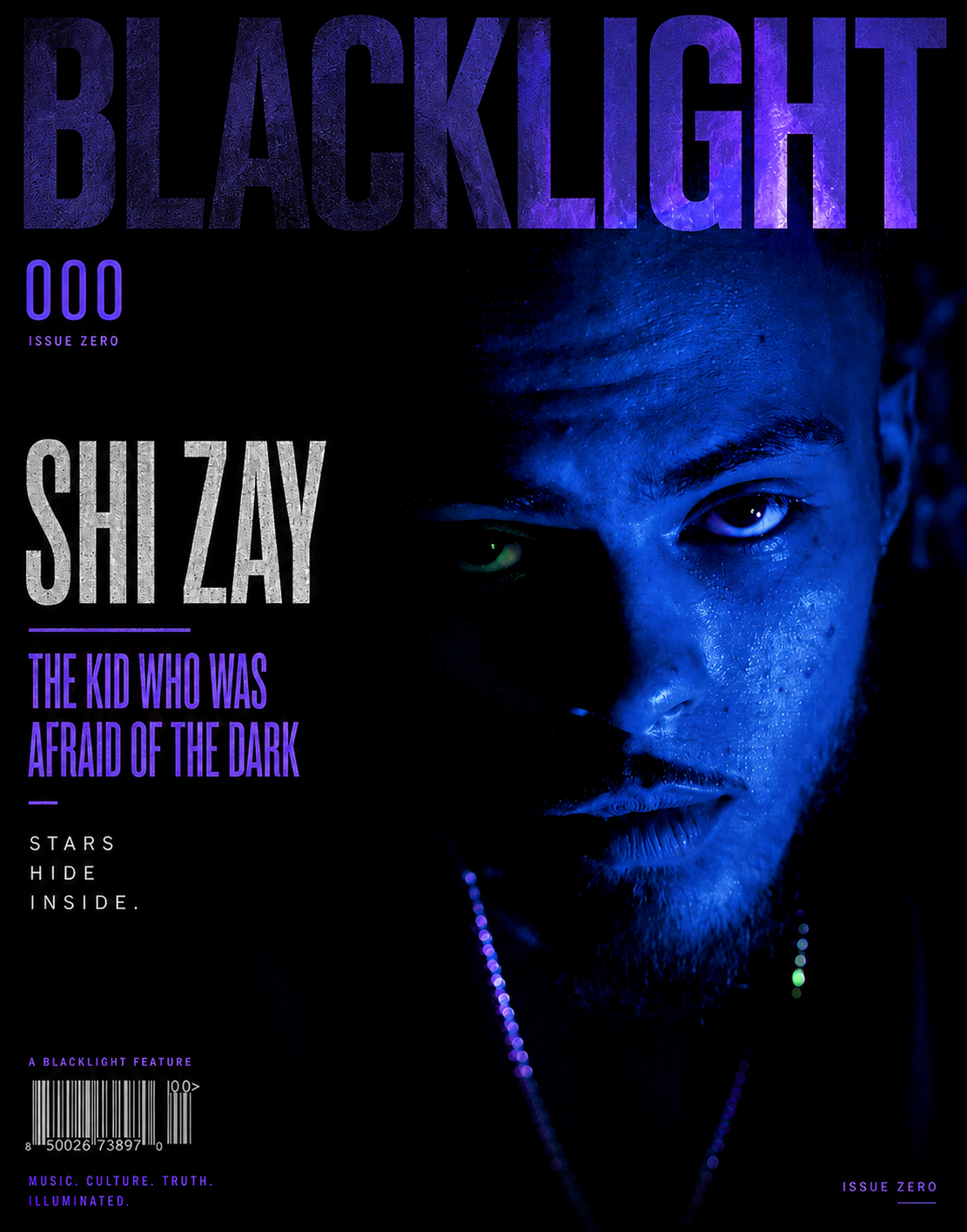
BLACKLIGHT 000 / SHI ZAY
THE KID WHO WAS AFRAID OF THE DARK
Before there was Blacklight, before Stars Hide Inside became a philosophy, before Shi Zay learned how to walk toward the things that frightened him, there was Isaiah—a little boy afraid to be alone in the dark.
Some nights, Isaiah Shinnery would wake up at two or three in the morning.
He wouldn't necessarily wake his parents. Sometimes he would simply leave his room, walk to their bedroom door, and stand there.
He was scared.
Years later, Isaiah would create somebody who could walk into places that he couldn't.
His name was Shi Zay.
Not another personality. Not a disguise.
Armor.
“Shi Zay is like my armor,” Isaiah says. “When Isaiah can't do it, somebody's got to.”
In the beginning, that armor was built for ambition. Shi Zay could be more fearless. More relentless. He could chase the things Isaiah wanted even when pursuing them scared him.
The name itself carried home with it. SHI is the beginning of Shinnery. It also came to carry the philosophy Stars Hide Inside—the belief that something extraordinary can exist before anyone else has learned how to see it.
But neither Isaiah nor Shi Zay could have known how much that armor would eventually be asked to carry.
BLACKLIGHT 000
BEFORE THE LIGHT
Loss didn't arrive once.
Isaiah lost his brother Ant to suicide.
He remembers recognizing that something wasn't right before it happened. He checked on his brother. Tried to get him to open up. Ant told him he was fine.
Then he was gone.
Five months later, Isaiah's best friend Dev was murdered.
Dev was more than a friend. He was another brother.
Isaiah remembers the drives they used to take together. He remembers sitting in Dev's passenger seat. He remembers warning him to protect himself because people couldn't always be trusted.
And he remembers the cruelty of not being there on the drive when Dev was killed.
There is a particular kind of grief in loving someone you could not save.
For Isaiah, it became two.
Then came the questions.
Why couldn't he have changed something?
Why wasn't he close enough?
Why wasn't he there?
And eventually:
Why should he still be here?
BLACKLIGHT 000
THE HIGHWAY
There are songs an artist writes.
And then there are songs an artist survives.
For Shi Zay, “THE HIGHWAY” belongs to the second category.
The record came from a period when grief had stopped feeling temporary. Isaiah describes living with suicidal thoughts and an overwhelming desire simply not to hurt anymore.
The central image of the song was brutally direct: driving until reaching the gates of heaven.
It wasn't a clever metaphor invented years afterward to make the story more dramatic.
It reflected where his mind could actually go at the time.
Music didn't magically fix that.
Shi Zay is careful not to pretend that recording one song made everything disappear.
But it gave the pain somewhere to go.
“The song didn't blow up and make me famous,” he says. “It gave me a smile on my face in the end of a battle that almost destroyed me.”
Today, when Shi Zay hears THE HIGHWAY, he doesn't hear the man he is now.
He hears someone who doesn't yet know he's going to be successful.
Not successful because millions of people will eventually know his name.
Successful because he doesn't quit.
He lives.
Asked what today's Shi Zay would tell that younger version of himself if he could sit beside him in the studio while THE HIGHWAY was being made, his answer isn't an inspirational speech.
He wouldn't say anything.
He'd let him finish.
He'd let that version of himself get every word out without interruption, because he doesn't know what might have happened if he hadn't.
And today, he can finally look back at that person with pride.
The road continued.
BLACKLIGHT 000
THREE SONGS, THREE WINDOWS
If Shi Zay could introduce himself through only three records, he wouldn't simply select whichever ones had the biggest numbers.
He would choose “die4u,” “FIRE AND ASH,” and “THE HIGHWAY.”
die4u, the final song on his NUMB EP, reveals the part of him capable of loving someone deeply enough that love begins turning into suffering—the experience of desperately wanting something to work while reality seems determined not to let it.
FIRE AND ASH reveals something underneath nearly everything else:
Faith.
Shi Zay describes God not simply as his creator, but almost as his closest friend.
That faith gives him a particular kind of fearlessness—not the belief that nothing bad will happen, but the belief that he doesn't have to understand every outcome in order to keep moving.
And THE HIGHWAY reveals what happens when that confidence disappears.
Together, the records don't present three different artists.
They illuminate three parts of the same person:
love, faith, and survival.
BLACKLIGHT 000
WHEN THE LIGHTS GO OUT
There was a time when darkness itself scared Isaiah.
Today, darkness means something different.
He remembers praying through tears for God to help him stop suffering. Not for fame. Not for money.
Just relief.
He believes that prayer was answered—not through an instantaneous disappearance of every problem, but through a transformation in how he carried them.
The anger didn't vanish.
He can still get pissed off. Still yell alone in his car. Still have bad days.
What changed was his relationship with fear.
He had already watched his life appear impossible and then become livable again.
So now he has a metaphor for the moments when everything goes dark:
If God turns the lights off, maybe He's fixing the lights. And when they come back on, they'll shine brighter than before.
It isn't certainty about what tomorrow contains.
It's faith that darkness isn't sufficient evidence that tomorrow contains nothing.
BLACKLIGHT 000
LEARNING TO BE ISAIAH AGAIN
Spend enough time discussing Shi Zay and eventually another person starts appearing in the story.
Isaiah.
He likes World of Warcraft.
He loves Minecraft.
He can disappear headfirst into something that fascinates him.
He's drawn to the nostalgic gentleness of things that remind him of childhood—especially memories of simply sitting beside his brother and playing video games.
He's naturally something of a loner.
And after years of grief changing the person he had learned how to be, Isaiah says something striking about healing:
He's getting better at learning how to be Isaiah again.
That doesn't mean abandoning Shi Zay.
Isaiah believes he'll always need him.
Shi Zay is the part that walks onto the stage. The part that fights for what Isaiah wants. The part willing to be scared and move anyway.
Isaiah described the relationship almost like Shi Zay were his older brother:
He'll take the hits.
He'll get us through this.
He'll stand up for Isaiah.
But when the curtains close, Isaiah still gets to come home.
And these days, home contains something the darkest chapters of his life couldn't show him yet.
His own family.
BLACKLIGHT 000
DEV'ANT
Isaiah couldn't save his brothers.
For a long time, that reality helped break him.
Today, his firstborn son carries both of them in his name.
Dev'Ant.
Dev.
Ant.
Two people Isaiah lost, carried forward by somebody he gets to raise.
Fatherhood hasn't erased grief. It has changed what continuing can mean.
Isaiah speaks about his brothers as still being part of his life. He notices twos. He notices moments he experiences as signs. At Purple Heart Park, his childhood skatepark, he still notices the same kind of bright red bird he remembers watching with Ant.
He interprets those moments through his faith.
To him, they're reminders:
They're still with me.
And if Isaiah keeps going, something of all three brothers keeps moving forward.
BLACKLIGHT 000
FALL. GET UP. TRY IT AGAIN.
Music wasn't Isaiah's first language for this.
Skateboarding was there when he was six or seven years old.
He stepped away from it for years as music became more important.
Then, after losing his brothers, he returned.
The last time he'd been at the skatepark before Dev's death, Dev had gone with him.
When Isaiah eventually returned to the park, he met Ridge.
Another brother entered his life in a place haunted by the absence of one he'd just lost.
That relationship eventually grew into Dry Bones. Ridge sponsored Isaiah as his first sponsored skateboarder. The team expanded. A family formed around it.
Then came Skate for Life.
And at Purple Heart Park—roughly a minute from the home where Isaiah grew up—Shi Zay gave his first performance.
The childhood skatepark.
The memories of his brothers.
Skateboarding.
Music.
A new family.
One location.
Full circle.
Maybe that explains why skateboarding fits Shi Zay so naturally.
He describes himself as the guy willing to jump down a stair set, eat shit, stand back up, and want another attempt.
Pain doesn't automatically mean stop.
Sometimes it means:
You didn't land it yet.
BLACKLIGHT 000
WHAT BLACKLIGHT SAW
Blacklight came into this interview looking for Shi Zay.
We found Isaiah.
And underneath both names, we found a little boy afraid of the dark.
He grew up believing he needed armor to face it.
Then life showed him darkness considerably greater than the kind inside a childhood bedroom.
Some of it nearly consumed him.
But something changed.
The armor stopped being about pretending fear didn't exist.
Shi Zay became proof that Isaiah could be afraid and still move.
His music became somewhere suffering could be placed.
His faith became somewhere uncertainty could be placed.
Skateboarding taught his body what his life would repeatedly demand from his spirit:
Fall. Get up. Try again.
And fatherhood gave survival somewhere new to go.
Isaiah once felt powerless to save the people he loved most.
Today, part of his life is devoted to trying to leave something useful behind for people he may never meet.
He hopes the music he made while he was broken can help put some of the pieces back together in somebody else.
Not because he believes he can save everybody.
Because he knows what it feels like to need something—anything—that gives you a reason to keep moving.
That's what Blacklight saw.
Not an artist who conquered darkness.
A man who learned that darkness didn't get the final word.
BLACKLIGHT 000
THE DARK DON'T SCARE US
Tonight, there are stars outside.
Isaiah needs to take a dirty diaper to the dumpster.
His son comes with him.
It's dark outside.
The kind of dark that once would have frightened Isaiah as a little boy.
But his son doesn't seem particularly bothered by it.
Isaiah looks at him and starts teaching him something anyway.
“Son, say, ‘The dark don't scare me. The dark is scared of me.’”
They keep walking.
Above them are the stars.
His son is eager to experience the world.
And Isaiah notices that.
He doesn't take all the credit for the boy's fearlessness. He doesn't need to.
Maybe he's just grateful that his son gets to begin somewhere different from where he did.
The little boy who once stood outside his parents' bedroom because he was afraid to be alone in the dark is outside now.
He's carrying forward the people he lost.
He's raising somebody new.
And he's teaching his son:
The dark don't scare us.
The dark is scared of us.