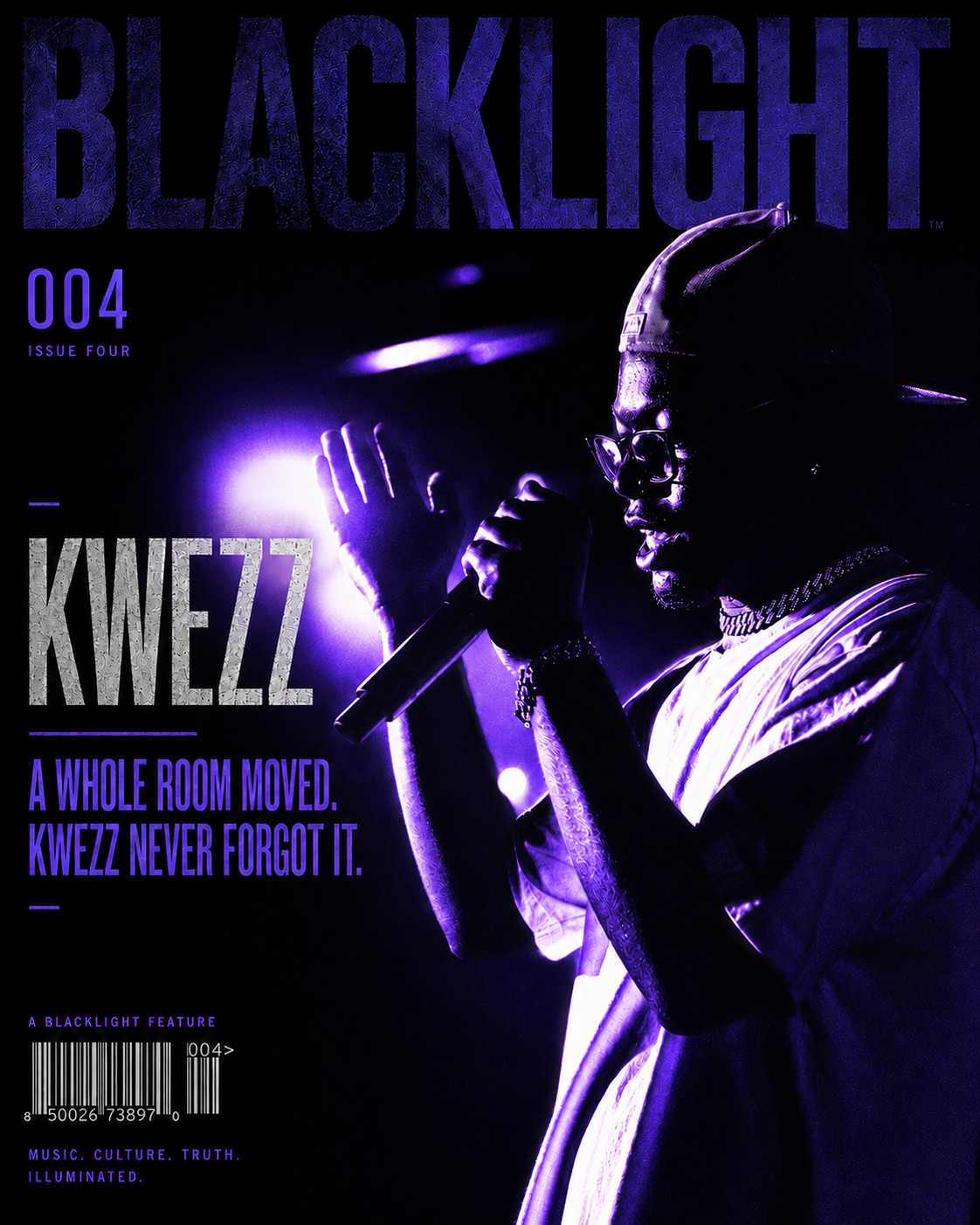
BLACKLIGHT 004 / KWEZZ
A WHOLE ROOM MOVED. KWEZZ NEVER FORGOT IT.
The night KWEZZ realized he could move a room changed what music meant to him. What followed was a years-long lesson in vulnerability, instinct, and learning how much of himself he could put into every record.
The room changed when the beat dropped.
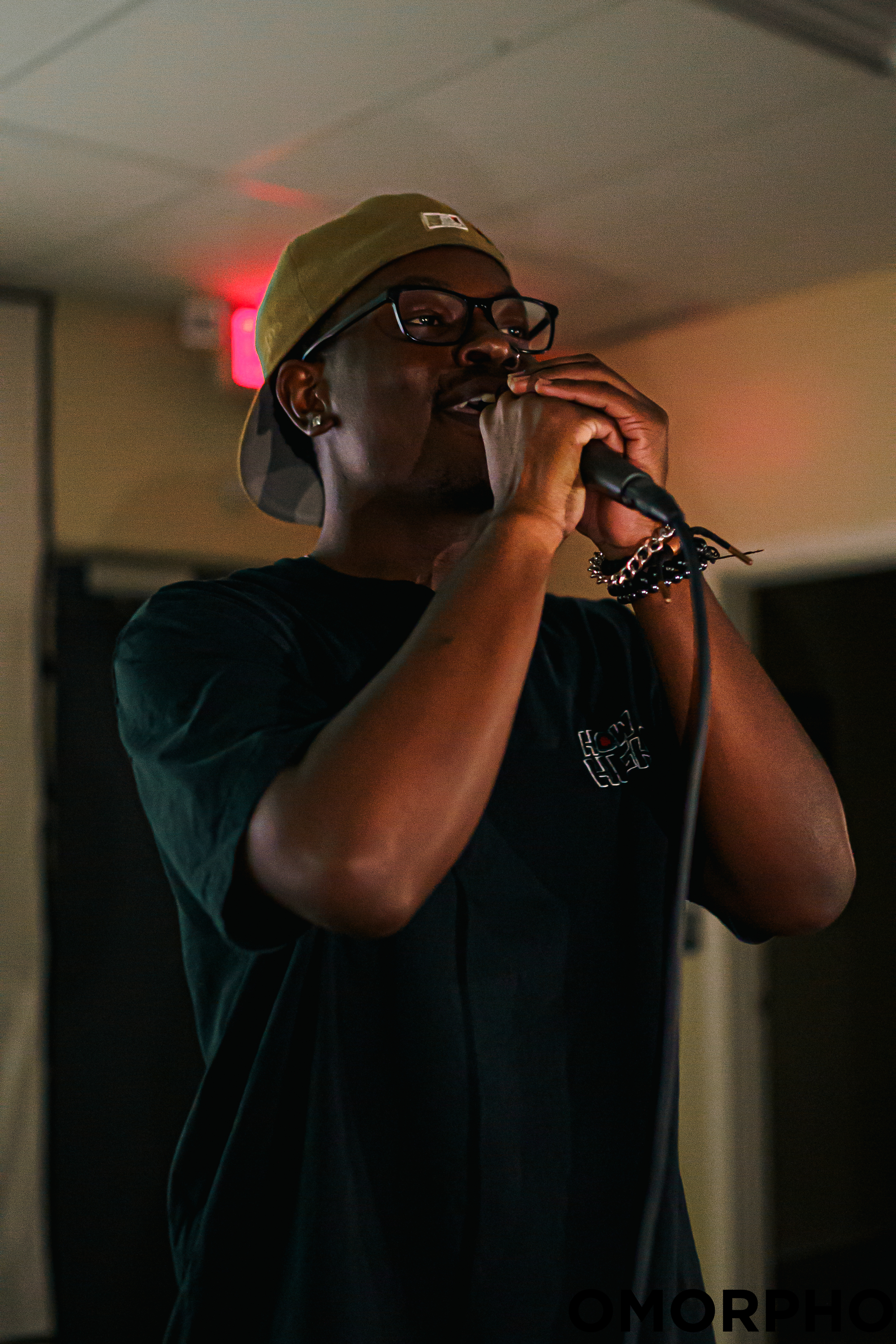
KWEZZ was performing at a Tucson show he had put together with his friend Javi. It wasn’t some massive industry showcase. It was early enough in his journey that the night could have easily passed as another local performance.
Then the crowd went up.
There’s still a video of it somewhere: KWEZZ performing, the beat dropping, and the people in front of him suddenly going crazy.
For him, the significance wasn’t simply that they liked the song.
It was what their reaction showed him.
“Something I created can make a whole group of people move.”
That was when music stopped feeling like something he was merely trying.
“That’s when it really clicked for me,” he says. “This is something that I really wanna do, that I would not mind doing for the rest of my life.”
After the show came another kind of confirmation.
People who had never heard of him showed love. People he had gone to school with were seeing this side of him. He met new people. What stayed with him was the amount of appreciation surrounding the performance and the craft itself.
“That’s something that I gotta carry with me for the rest of my life.”
A few years earlier, KWEZZ wasn’t even thinking about becoming a rapper.
He was around 17, in his junior year of high school, watching The Get Down on Netflix. At the time, his attention was elsewhere — playing drums, dancing. His older sister already rapped, but KWEZZ had no real interest in following her into it.
Then the show caught him.
He watched artists build music, create in the studio and turn what they were going through into songs.
He loved it enough to show his sister.
Look how cool this is.
Her response was simple:
Why don’t you try it?
KWEZZ remembers asking whether she really thought he should.
“Yeah bro, you never know what could happen.”
So he tried.
He started writing raps in notebooks and on his phone.
“The rest is history.”
It isn’t the kind of origin story where somebody spends childhood announcing that they were destined for a microphone.
KWEZZ found the door.
Someone close to him told him to walk through it.
Then he kept walking.

KWEZZ is originally from Dublin, Georgia, but his story doesn’t come packaged with the exaggerated mythology artists are sometimes expected to build around themselves.
He doesn’t pretend otherwise.
“I didn’t have the worst type of background or anything like that,” he says. “I had my own fair share of struggles and stuff like that, but I was never super, super in the streets or nothing like that.”
His explanation of himself is much simpler.
“I just love the music, dude.”
That simplicity matters.
For KWEZZ, authenticity increasingly became less about proving what he had survived and more about allowing what was actually happening in his life to reach the music.
That realization took time.
Eventually, it became a song.
On August 10, 2024 — his 23rd birthday — KWEZZ released Live and Learn.
He describes the project as exactly what its title suggests: a record shaped by lessons.
Lessons about himself.
Relationships.
Hardships.
Life.
Experiences somebody else might hear and recognize themselves inside.
One of those songs was “TIME.”
When asked to choose between three records — “Try Me,” “TIME,” and “Come Over” — KWEZZ chooses “TIME.”
Not because the other two mean less.
“All three of those are special in their own right.”
But “TIME” carries something different.
“There’s a whole story, a whole background just specifically for that song.”
The relationship behind it was real.
So were the details.
“Basically everything that happened in the song happened in real life.”
One detail he points toward is something almost anyone who has lost a relationship can understand: deleting the photos from his phone.
To KWEZZ, the action carried more weight than it might appear to from the outside.
“It’s just one of those super vulnerable moments.”
Vulnerability was not something he had always trusted himself to put this directly into the music.
“That was one of the first times I felt like I could actually speak about this in music.”
Later, he puts the realization more plainly.
“It was the first time I realized I could really talk about real stuff instead of just faking and doing things that aren’t true to myself.”
That shift did more than change what KWEZZ wrote about.
It changed how he made records.
Earlier in his development, KWEZZ would write verses down and record them later.
Sometimes days would pass.
The words would still be there.
The original feeling might not.
“I feel like once you write down a verse and then it’s been a couple days before you can record it, that takes away the feeling that you first had when you began to write it.”
As he became more comfortable creating music, he gradually stopped physically writing as much.
Instead, he began punching in and freestyling.
The goal wasn’t convenience.
It was staying closer to the emotion.
“When I do that, I feel like it’s much more authentic. It feels more raw.”
Instead of writing from one emotional state and trying to reconstruct it later, he could enter the booth while the feeling was still present.
“You can feel the emotion when I’m in that moment creating the music.”
Eventually, he realized he didn’t have to manufacture the right mental state before recording.
“I can just hop in the booth whenever I’m feeling that feeling and then just go crazy.”
There is a circle in that.
At 17, what caught KWEZZ’s attention was watching artists take what they were living through and put it into music.
Years later, he had to discover how to do that for himself.
None of that means he believes he has figured everything out.
Quite the opposite.
Ask KWEZZ where he believes he actually is as an artist — separate from social media, numbers or anybody else’s expectations — and his answer comes quickly.
“I feel like I still have untapped potential.”
Then he goes further.
“I haven’t even reached my prime yet.”
There are things he knows he needs to improve.
Consistency is one.
Sometimes he will release a song and realize days later that he barely told anyone it existed.
Finishing songs is another.
Then there is the harder problem: his own head.
He catches himself thinking backward.
“I could have been this far ahead if I did this.”
“I wish I didn’t do this, so I could have did this instead.”
Those alternate versions of the past can create an endless measurement against a life that never actually happened.
“As I’m getting older, I’m realizing that it’s never good for anybody to think like that.”
He says he is getting better at leaving those thoughts alone.
They haven’t completely disappeared.
Neither has the question underneath them.
Why aren’t you further already?
KWEZZ started making music around 18.
He watches artists emerge now who began at 13 or 15. Others seem to appear and break through almost immediately.
He knows what somebody encountering his catalog might think.
“You’ve been rapping for this long. Why ain’t you blow up yet?”
He doesn’t pretend to have a perfect answer.
“I wish I could answer that question.”
Then comes the part that matters.
“But hey, you know, it is what it is. We gonna keep doing this shit.”
There isn’t a grand motivational speech attached.
No invented explanation for why it hasn’t happened yet.
He simply continues.
Maybe that makes more sense once you know what KWEZZ is actually measuring.
“Fuck followers, fuck numbers, fuck all of that shit,” he says. “I’m just saying in my own head.”
He is describing a different unfinished goal.
“I haven’t even reached the pinnacle of my own skill when it comes to making and creating songs.”
Even if the outside world decided tomorrow that KWEZZ had arrived, he might not agree.
He believes there is another version of himself ahead.
And when he describes that future, it extends far beyond streaming numbers.
He wants to sell out shows.
Create merchandise.
Make vinyl.
Build collaborations.
Design things.
Tell stories through music videos and scripted visual concepts.
He wants more ways to express what exists in his head through music, visuals and physical objects.
“I got hella ideas I want to express.”
But when asked what would actually change if everything went his way, none of those things comes first.
“Family is good. It’s the number one thing.”
Success, to KWEZZ, means becoming the person people close to him can call when they need something.
“They don’t gotta worry about nothing.”
He also wants to give back — both to the community he was born into and the community that raised him in Arizona.
Then there is the reason beneath the records themselves.
“Just being able to touch people’s souls through music,” he says. “It’s the biggest thing I’ve ever wanted ever in life.”
There is another tension KWEZZ has started noticing.
People hear the songs.
They see snippets.
Old performances.
Videos.
Release posts.
But he wonders how much they actually know him.
“People are missing more of my personality outside of music.”
He has spent years getting people to hear KWEZZ.
Now he is thinking more about letting them meet him.
“I’m still a human being type shit.”
That may explain where his next phase is headed.
More storytelling.
More videos.
Scripts.
More visual ideas surrounding the songs.
A larger world around the music rather than an endless sequence of links asking people to press play.
It is another version of the same lesson he has been learning since the beginning:
Put more of yourself into the work.
At 17, KWEZZ watched other artists do it on a television screen and wondered what it might feel like.
His sister told him to try.
Then a room moved because of something he made.
A relationship became “TIME.”
Vulnerability changed the way he wrote.
The way he wrote changed the way he recorded.
And the artist who once wasn’t even thinking about becoming a rapper now talks about doing this for the rest of his life.
That doesn’t mean KWEZZ believes he has arrived.
If anything, he seems more interested in what remains.
More music.
More honesty.
More stories.
More ways to build something people can feel.
“I know I’m capable of so much more.”
A whole room once showed KWEZZ what something he created could do.
He never forgot it.
Now he wants to see how much further it can move.
WHAT BLACKLIGHT SAW
KWEZZ doesn’t talk like somebody trying to manufacture a mythology around himself. That’s part of what makes the story work. He’ll tell you where he struggled, where he was still figuring things out, and where music started becoming something more serious than just an idea. The turning point wasn’t some industry co-sign or overnight moment. It was a room in Tucson moving with him, and realizing in real time that what he was making could actually reach people.
The same honesty shows up in the music. “TIME” matters because he let himself be vulnerable enough to put a real breakup into the record instead of hiding behind an image. “Try Me” carries a different energy, but the thread is the same: KWEZZ sounds strongest when he isn’t trying to become somebody else.
What BLACKLIGHT saw was an artist still building, but already clear on one thing: authenticity matters more to him than pretending he’s further along than he is. And sometimes that clarity is the part worth paying attention to first.